Amazon's Investment in Anthropic: A $33 Billion Bet on AI Infrastructure

Amazon's Investment in Anthropic: A $33 Billion Bet on AI Infrastructure
Amazon has committed to investing up to $25 billion in Anthropic, the AI company behind the Claude chatbot, adding to the $8 billion already deployed since 2023. The deal, announced in April 2026, represents one of the largest corporate investments in an AI startup to date and it comes with strings attached that reveal as much about cloud computing economics as they do about artificial intelligence.
The structure breaks down like this: $5 billion goes to Anthropic immediately, with the remaining $20 billion contingent on "certain commercial milestones" that neither company has publicly detailed. In exchange, Anthropic has pledged to spend more than $100 billion on Amazon Web Services technologies over the next decade, including current and future generations of Trainium chips and tens of millions of Graviton CPU cores.
Why Amazon Continues to Invest in Anthropic
The cynical read is that this is a cloud contract dressed up as an investment. Amazon puts in $25 billion and gets a commitment for $100 billion in AWS spending a 4:1 return before accounting for whatever equity appreciation Anthropic delivers. That's not wrong, but it misses the strategic picture. Amazon's cloud business faces genuine competition from Microsoft's partnership with OpenAI and Google's vertically integrated approach with Gemini. Having Anthropic which many researchers consider the technical leader in safety-focused AI development locked into AWS infrastructure gives Amazon a differentiated offering that Azure and Google Cloud can't replicate.
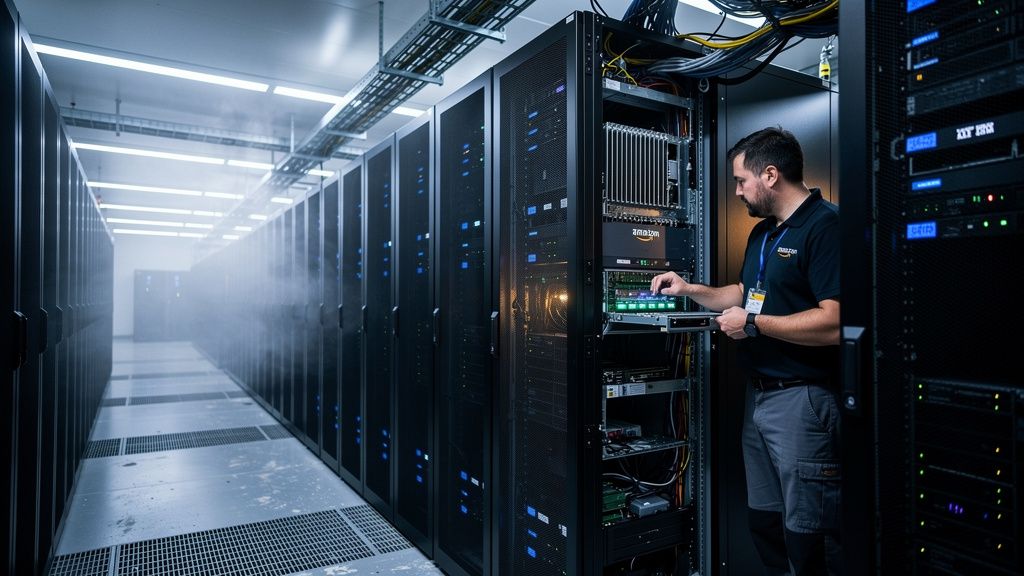
According to the New York Times, Anthropic has become one of the largest users of Amazon's Trainium chips over the past year. The new deal secures up to 5 gigawatts of computing capacity for Anthropic, with significant Trainium3 chip capacity expected to come online later this year. For context, 5 gigawatts is roughly the power consumption of a small city training frontier AI models has become an infrastructure challenge as much as a research one.
Amazon CEO Andy Jassy has framed the company's AI spending as essential to remaining competitive. Amazon disclosed in February 2026 that it expects to spend approximately $200 billion on capital expenditures this year, with most of that directed toward AI infrastructure. The Anthropic investment represents a significant but not overwhelming portion of that outlay, and it comes with the advantage of guaranteed revenue through the AWS commitment.
Anthropic's Position in the AI Landscape
Anthropic occupies an unusual position among AI companies. Founded in 2021 by former OpenAI researchers, including siblings Dario and Daniela Amodei, the company has positioned itself as the safety-focused alternative to OpenAI's more aggressive deployment strategy. Its Claude models consistently rank among the top performers on benchmarks, and the company has been more transparent about its alignment research than most competitors.
The $380 billion valuation from its Series G round in February 2026 makes Anthropic one of the most valuable private companies in the world. Business Insider reported that Amazon's stake alone may have appreciated to over $60 billion a seven-fold increase from the original investment basis. Whether that valuation holds up depends heavily on factors nobody can predict with confidence: the pace of AI capability improvements, the regulatory environment, and whether Anthropic can convert research leadership into durable commercial advantage.
Anthropic's actual revenue and profitability figures aren't publicly available. The company has been cagey about those numbers, which is common for private AI companies but makes it difficult to assess whether the valuation reflects genuine business fundamentals or speculative enthusiasm about future capabilities.
The AWS Infrastructure Commitment
The $100 billion AWS spending commitment over ten years has received less scrutiny than it warrants. By pre-committing to that level of cloud infrastructure spending, Anthropic is locking itself into Amazon's ecosystem for the foreseeable future a significant bet on AWS maintaining competitive pricing and performance, and on Anthropic's own growth trajectory being steep enough to justify the outlay.
The arrangement makes Anthropic something closer to an AWS customer with equity characteristics than a traditional investment target. Amazon secures guaranteed cloud revenue regardless of whether Anthropic's products succeed in the market. On the other side, Anthropic gains access to capital and infrastructure without the pressure of an IPO or the governance complications of a full acquisition and both parties walk away with impressive numbers to announce.
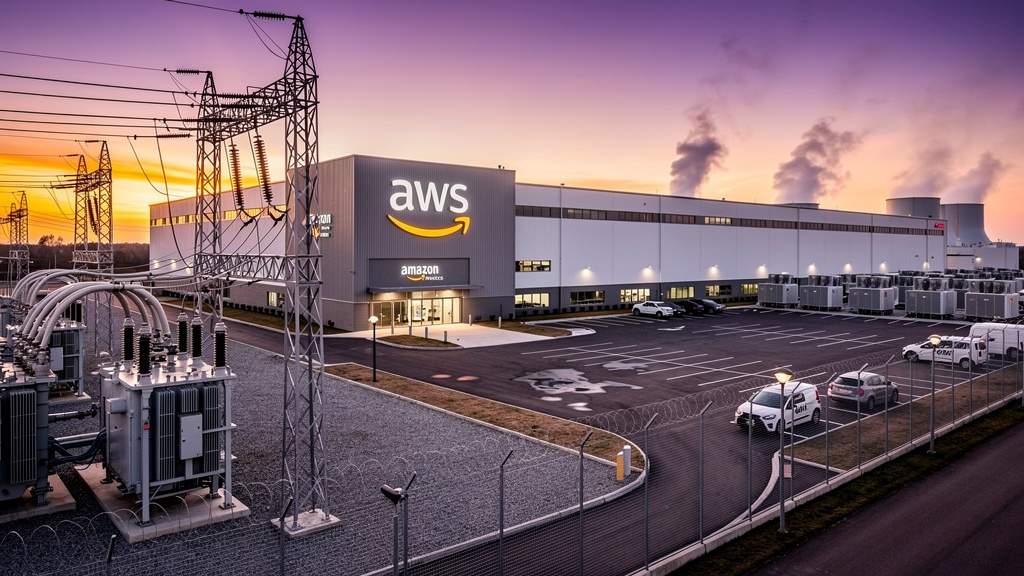
What's less clear is how this affects Anthropic's independence. The company will use AWS Trainium and Inferentia chips to train and deploy future foundation models, with AWS serving as both primary cloud provider and primary training partner. That's a deep technical integration that would be expensive and time-consuming to unwind. If Amazon's chips underperform Nvidia's offerings which remains a possibility despite Amazon's significant investment in custom silicon Anthropic may find itself at a competitive disadvantage.
How This Compares to Microsoft-OpenAI
The obvious comparison is Microsoft's relationship with OpenAI, which has involved approximately $13 billion in investment and similarly deep Azure integration. The Amazon-Anthropic deal is larger in headline dollar terms, though the milestone-contingent structure of the additional $20 billion muddies any straightforward side-by-side reading of the two arrangements.
One meaningful difference: Microsoft has reportedly negotiated significant control provisions with OpenAI, including board representation and access to technology. Amazon has explicitly maintained a minority investor position in Anthropic, which suggests less direct influence over company strategy. Whether that's better or worse depends on your perspective it preserves Anthropic's independence but also limits Amazon's ability to steer the company's direction.
Google has taken a different approach entirely, investing $2 billion in Anthropic while simultaneously developing its own Gemini models in-house. That hedged strategy may look smart if Anthropic falters, but it also means Google lacks the deep integration that Amazon and Microsoft have achieved with their respective AI partners.
What This Means for Claude Users
For enterprises using Claude through Amazon Bedrock AWS's managed service for foundation models the deal signals continued investment in the platform. AWS customers will get early access to fine-tuning capabilities on Anthropic models, a customization benefit they will "uniquely enjoy for each model for a period of time."
The international expansion component is worth noting. Both companies plan to extend inference capacity globally, which should improve latency for Claude users outside North America. The current infrastructure is heavily concentrated in US data centers, and international enterprise customers have complained about performance gaps.
For individual Claude users, the practical impact is harder to predict. Anthropic has maintained that it will continue offering Claude directly through its own interfaces, not just through AWS. But the economic incentives now point strongly toward AWS as the primary distribution channel, and Anthropic may well prioritize features and capacity for Bedrock customers over direct users.
Unresolved Risks in the Amazon-Anthropic Partnership
The deal raises questions that won't be resolved for years. Whether Anthropic's safety-focused approach can hold up commercially against competitors willing to deploy more aggressively is one. Amazon's custom chips still have to prove themselves against Nvidia's grip on AI training hardware. And it's not clear that regulators will let these massive AI investment structures stand antitrust scrutiny could eventually force a restructuring of partnerships like this one.
The $100 billion AWS commitment assumes that Anthropic will continue scaling at a pace that requires that level of infrastructure spending. If AI capability improvements plateau a possibility that some researchers consider increasingly likely that commitment could become a burden rather than an advantage. If capabilities keep accelerating, though, $100 billion over a decade might turn out to be the cheaper scenario.
Amazon's investment in Anthropic reflects a broader truth about the current AI moment: the companies best positioned to benefit are those that control infrastructure. Whether you're building AI models or deploying them, you need massive amounts of compute, and the cloud providers are the gatekeepers. Amazon is betting that by funding Anthropic's research while locking in its cloud spending, it can capture value on both sides of that equation a reasonable wager, perhaps, but one where being wrong carries a price tag measured in tens of billions of dollars.