The History of Balenciaga: From a Spanish Fishing Village to the Heights of Global Fashion

The History of Balenciaga: From a Spanish Fishing Village to the Heights of Global Fashion
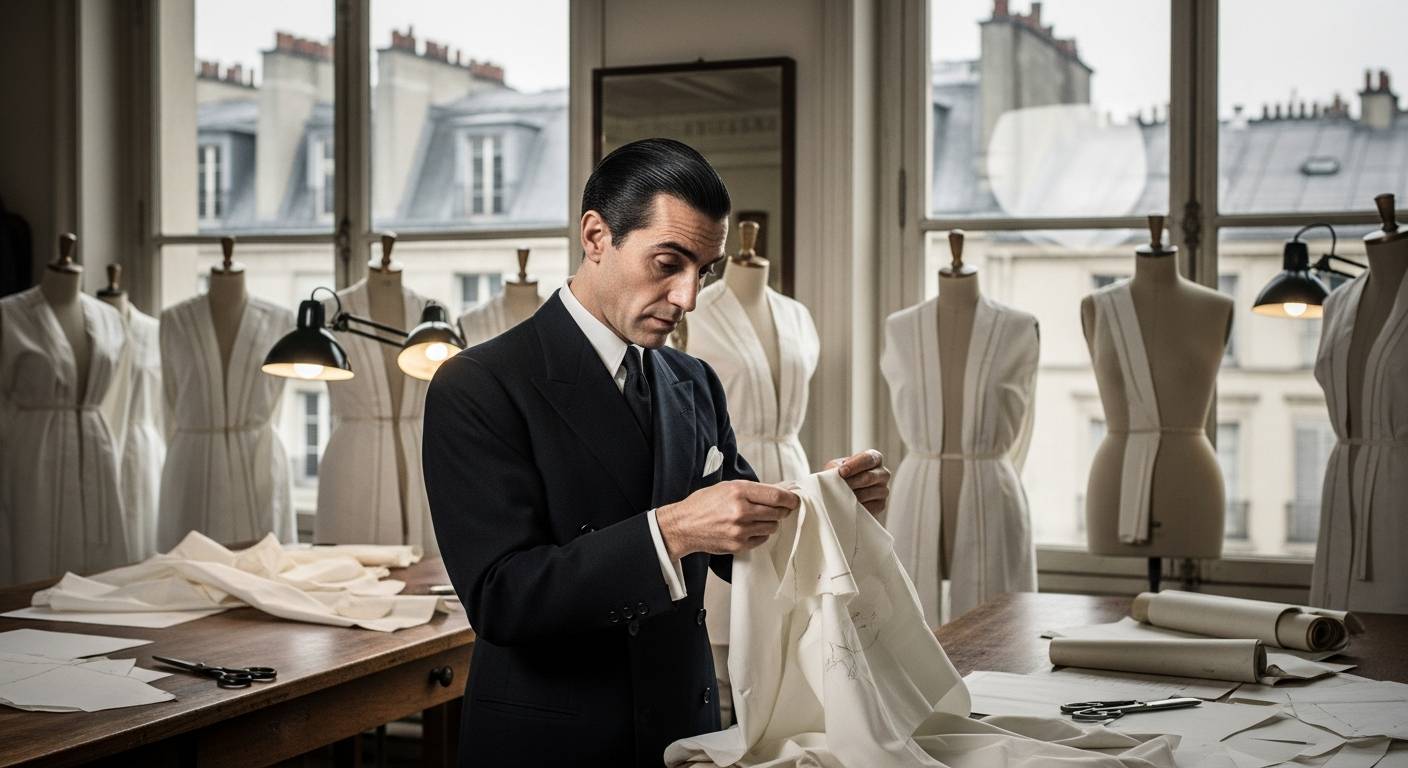
Few fashion houses have a story as genuinely strange and compelling as Balenciaga's. The history of Balenciaga begins not in Paris or Milan but in Getaria, a small Basque fishing village on the northern coast of Spain, where Cristóbal Balenciaga was born in 1895 to a seamstress mother and a father who died while Cristóbal was still young. That origin modest, coastal, working-class shaped everything that followed, including the designer's almost pathological aversion to celebrity and his insistence that the clothes do all the talking.
What followed over the next century is a story of bankruptcy, civil war, exile, creative resurrection, and corporate reinvention that most fashion brands simply don't survive.
Cristóbal Balenciaga and the Making of a Couturier
The turning point in Cristóbal's early life came through an encounter that sounds almost too cinematic to be true. He and his mother were visited by the Marquesa de Casa Torres, a Spanish aristocrat who had hired his mother as her personal seamstress. During one of her fittings, the young Cristóbal somewhere around 12 years old at this point complimented the Parisian tailoring of the Marquesa's outfit with enough precision and specificity that she took notice. Impressed by his eye, she arranged an apprenticeship in tailoring for him, the kind of opportunity that simply wasn't available to someone from his background without exactly that kind of patronage.
He made the most of it. By his early twenties he had built enough of a clientele drawn largely from the Spanish noble class he'd been introduced to through the Marquesa to open his own couture boutique. Couture, in the strict sense, means custom one-of-one garments, typically dresses, made to a specific client's measurements. His clients weren't walking in off the street; they were aristocrats commissioning pieces for galas, weddings, and the kind of formal events where wearing something nobody had ever seen before was the whole point. Cristóbal's reputation was built on an unusual fusion of Japanese and European design sensibilities, and that distinctiveness kept his order books full.
Then Spain's political situation dismantled everything he'd built, twice.
In 1931, the Spanish monarchy was abolished, which restructured the country's class system in ways that were immediately catastrophic for a couturier whose entire client base was the noble class. Cristóbal declared bankruptcy by year's end. He recovered, expanded opening two new locations in Madrid and Barcelona under the name Eisa, a tribute to his mother's surname, Eisaguirre and seemed to have found stable footing again. Then in 1936, the Spanish Civil War broke out and forced him to close all three boutiques. Twice bankrupt, twice rebuilt, he made the decision that would define the rest of his career: he moved to Paris.
Paris and the Rise of the House of Balenciaga
He arrived in 1937 and made one immediate, deliberate choice: he dropped his first name. The couture house would simply be Balenciaga. That August he presented his first Parisian collection, which was well received but not yet transformative. The real breakthrough came in 1939, with a collection heavily inspired by 17th-century Spanish fashion. The ongoing Civil War in Spain gave the collection a layer of cultural weight that resonated far beyond the usual fashion press, and a sketch of the collection's infanta dress appeared in Vogue, illustrated by the artist Carl Erickson. That single image helped spread Balenciaga's influence internationally in a way that would have taken years otherwise.
One month later, World War II began.
Wartime is generally terrible for luxury fashion materials are rationed, international trade collapses, and the social events that drive demand for couture simply stop happening. But Balenciaga was one of the few houses that continued operating through the war, and certain pieces, including the square coat, were popular enough that clients reportedly traveled to Paris specifically to buy them despite the obvious risks. By 1945, when the war ended, Balenciaga was in stronger shape than most of its competitors, many of whom had seen sales collapse and material costs spiral upward.
The recovery of French fashion as a whole owed something to an unlikely source: Robert Ricci, son of couturier Nina Ricci, who organized a traveling exhibition called the Théâtre de la Mode. The concept was elegant in its practicality rather than producing full-scale garments, participating designers dressed one-third-scale wire mannequins, which required a fraction of the material. The first showing was held at the Louvre in Paris and featured 237 mannequins representing the work of nearly 60 designers, including Balenciaga, Hermès, Balmain, and Lanvin. The exhibition then toured Europe and the United States. For designers who were already famous among wealthy clients, the Théâtre de la Mode introduced their work to an entirely different public people who would never commission a couture gown but who left with a genuine appreciation for fashion as a craft. That shift in public consciousness mattered for the industry's long-term health in ways that are hard to quantify but easy to trace.
Through the late 1940s and into the 1950s, Cristóbal continued doing what he'd always done: designing against the grain. In 1955 he introduced the Balenciaga tunic, a loose, unconstructed silhouette at a moment when the rest of the industry was moving toward tighter cuts, sharper tailoring, and increasingly elaborate patterns. Two years later came the sack dress shapeless by conventional standards, deliberately so, rejecting the nipped waist that had defined postwar fashion. These weren't just aesthetic choices; they were arguments about what fashion for women should be allowed to do. Christian Dior, who was by any measure one of Cristóbal's chief competitors, reportedly said: "Haute couture is like an orchestra for which only Balenciaga is the conductor. The rest of us are just musicians following the directions he gives us." That quote gets repeated often enough that it risks becoming wallpaper, but it's worth pausing on this was a rival, not an acolyte, saying it.
Retirement, Death, and the Long Silence
In 1968, after nearly five decades in fashion, Cristóbal Balenciaga announced his retirement and declared that the house would close permanently. He was not interested in handing it off. This confused people at the time and still prompts questions he had trained designers who went on to define the industry, including Hubert de Givenchy and Oscar de la Renta, and he reportedly redirected many of his clients to Givenchy upon retiring. But passing the house itself to someone else wasn't something he was willing to do.
Understanding why requires understanding the man. Cristóbal never spoke to the press during his working years. He didn't attend his own runway shows. In his entire career he gave exactly two interviews, both to the French magazine Paris Match, and both after he had already retired. The house of Balenciaga was never a brand to him in the modern sense it was a vehicle for his work, and when he stopped working, the vehicle had no purpose. He died in 1972 at 77. Women's Wear Daily ran the headline: "The King Is Dead." Coco Chanel had once called him "the only true couturier left," and the sentiment at the time of his death was that something genuinely irreplaceable had left the industry.
The Corporate Resurrection and What Cristóbal Would Have Thought
Because Cristóbal died unmarried and without children, the rights to the Balenciaga name passed to a nephew, who had no background in fashion and sold them to Hoechst, a German chemical manufacturer. Hoechst's interest was specific: Cristóbal had launched a Balenciaga perfume line in 1947, and it had done well enough that a chemical company with perfume interests could see the value in the name. So for a stretch of years, "Balenciaga" existed primarily as a fragrance brand technically alive, but nowhere near the fashion industry that had made it famous.
In 1986, the rights were sold again, this time to Jacques Bogart, another perfume company, which recognized that the Balenciaga name carried enough cachet in fashion to be worth reviving there. They brought in designer Michel Goma to create the brand's first-ever ready-to-wear collection a fundamental departure from everything Cristóbal had built, since ready-to-wear is essentially the opposite of couture: standardized sizing, mass production, available to anyone who can afford the retail price rather than to clients commissioning one-of-one pieces. Goma presented his first collection in October 1987, and it was, by most accounts, a failure not because he lacked skill, but because he was being asked to transform a couture house that had been dormant for nearly twenty years into a ready-to-wear brand, which is an almost impossible brief. He was widely criticized for abandoning the brand's identity without building anything coherent in its place.
His replacement in 1992, Josephus Thimister, fared somewhat better. Thimister who had worked under Karl Lagerfeld at Chanel is credited with modernizing the brand and returning it to something resembling high-end status. He was fired in 1997 after a runway show accompanied by a live electronic band so aggressively loud that audience members walked out mid-show. Whatever one thinks of that particular creative decision, the board's reaction was swift, and Thimister was gone.
What happened next was genuinely unexpected.
Nicolas Ghesquière and the Collection That Changed Everything
Balenciaga's board, scrambling for a replacement, promoted a 26-year-old in-house designer named Nicolas Ghesquière who had been working at the company for roughly five years. He had no experience running a fashion house, and the circumstances of his debut were almost comically constrained: four months to design a collection, no say in the venue, no input on the runway design, no ability to book the models he wanted. All he could control was the clothes.
He made them all black. And unlike Thimister's aggressively modern approach, Ghesquière's collection drew directly from Cristóbal's archive updated silhouettes, clear references, a deliberate act of historical recovery rather than reinvention. The response was immediate. Within a year of his debut, Ghesquière had reportedly received approaches from Gucci, LVMH, and Prada, as well as offers to launch his own label. He stayed at Balenciaga. In 2001, the house was acquired by Kering, the luxury group that also owns Gucci and Saint Laurent, which gave the brand the financial infrastructure it had been missing.
The City bag also known as the motorcycle bag or the lariat bag is probably the single most famous thing Ghesquière produced during his tenure, and its origin story is the kind of thing that gets turned into a case study in fashion schools. The board rejected it. Ghesquière had a few samples made that wound up backstage at one of his shows, where a group of models including Kate Moss saw them and told him they loved the bag. He gave 25 samples away as gifts. The models started carrying them everywhere, the bags appeared in paparazzi photos, and demand materialized before the product even existed at retail scale. The board reversed course. The City bag went on to become one of the most successful and widely imitated accessories in contemporary fashion, which says something both about Ghesquière's instincts and about how badly institutional caution can misfire.
Ghesquière left in 2012 to become creative director of women's wear at Louis Vuitton. His departure left a gap that proved difficult to fill Alexander Wang stepped in, presented six collections over roughly two years, and then departed in mid-2015 under circumstances that were never fully explained publicly. Wang suggested he wanted to focus on his own label; Balenciaga described it as a mutual parting. I don't think we'll ever get a more detailed account than that.
Demna and the History of Balenciaga Rewritten in Real Time
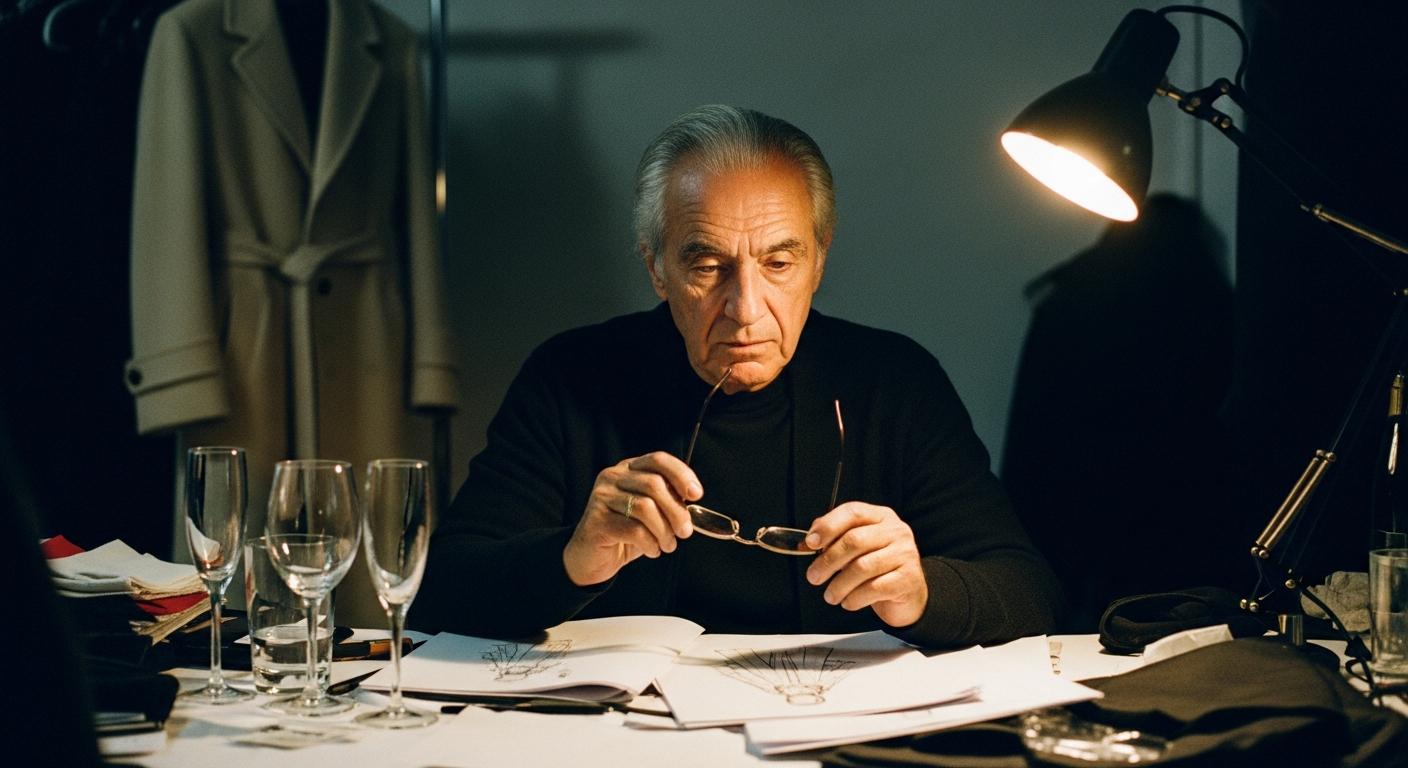
The appointment of Demna Gvasalia as creative director in 2015 was, in retrospect, one of the more consequential decisions in recent fashion history though it wasn't obvious at the time. Demna was born in Georgia in 1981, fled to Germany as a child to escape civil war (a biographical parallel to Cristóbal's own flight from Spain that feels almost too neat), eventually enrolled in economics at Tbilisi State University under parental pressure, and then abandoned that path to study fashion design at the Royal Academy of Fine Arts in Antwerp, graduating in 2006. He spent time designing women's wear at Maison Margiela starting in 2009, then moved to Louis Vuitton in 2013, where he briefly overlapped with the newly arrived Ghesquière.
In 2014, Demna co-founded Vetements with his brother Guram and a group of friends from Antwerp. The brand's name is literally the French word for "clothing," which is either the most pretentious possible name or the most deadpan, depending on your tolerance for that kind of gesture. Vetements set out to apply luxury construction and pricing to streetwear silhouettes oversized tops, extended sleeves, tightly tailored pants and it worked, partly because the clothes were genuinely interesting and partly because Demna understood that controversy is its own form of marketing. A collaboration with the shipping company DHL produced one of the most talked-about pieces of the mid-2010s: a red-and-yellow DHL logo tee retailing for several hundred dollars. The point wasn't subtlety. The point was that brand status is largely a social construction, and Demna wanted to make that visible.
He brought the same sensibility to Balenciaga. For the autumn/winter 2017 collection, he used Bernie Sanders' campaign logo lifted directly from the 2016 presidential race as the basis for a collection graphic. The election was already over by the time the collection dropped, so there was no endorsement implied, but the image had been everywhere for a year and placing it on a runway made a specific argument about how political imagery circulates through culture. Whether you find that interesting or irritating probably depends on how you feel about fashion as a site of cultural commentary more broadly, but dismissing it as lazy seems wrong to me there's a consistent logic running through everything Demna does, even when individual pieces feel provocative for its own sake.
The commercial results were undeniable. The Balenciaga Speed Trainer, debuted in November 2016, became one of the most visible luxury sneakers of its era almost immediately, retailing at close to $800 and appearing on seemingly every major celebrity within months. Then in 2017, Demna introduced the Triple S a chunky, stacked-sole sneaker that was the aesthetic opposite of the Speed Trainer's minimalism. The Triple S essentially launched what became known as the "dad shoe" trend, which every major fashion house then scrambled to replicate. Getting two culturally dominant sneaker silhouettes into the market in consecutive years, each defining a different aesthetic direction, is a rare achievement, and it's worth crediting Demna for reading the market well enough to know the Speed Trainer would saturate and offering an alternative before that happened.
In 2019, Demna announced he was leaving Vetements to focus entirely on Balenciaga. A few months later came the announcement that he was bringing couture back the first Balenciaga couture collection since Cristóbal's retirement in 1968. The show, held in July 2021 at Cristóbal's original Paris showroom, ran in complete silence no music, models walking a runway with no ambient sound and featured couture for men as well as women, something Cristóbal himself had never done under the Balenciaga name. The silhouettes referenced Cristóbal's archive directly. The color palette was predominantly black. Whether it fully honored the couture tradition or represented something adjacent to it is a question I genuinely can't resolve couture has a specific technical definition enforced by the Fédération de la Haute Couture et de la Mode, and I couldn't find clear documentation of whether this collection met those standards or was presented as couture in spirit rather than strict designation. That distinction matters, and the fashion press was somewhat vague about it.
What's not in question is what the collection represented symbolically: a fashion house that had spent decades as a ready-to-wear brand attempting to reconnect with the craft tradition that made its name worth reviving in the first place. Whether Demna's version of couture is what Cristóbal would have recognized as such is unknowable, but the attempt was serious, and the result was the most discussed Balenciaga collection in years.
The history of Balenciaga, traced from a fishing village in the Basque Country to a Paris showroom in 2021, is ultimately a story about what a name can survive bankruptcy, civil war, corporate ownership by a chemical company, two decades of dormancy, creative misfires, and the constant pressure to be simultaneously historical and new. Most brands don't make it through one of those. Balenciaga has made it through all of them, which is either a testament to the original work's strength or to the fashion industry's appetite for legacy, or both.