how to style curtain bangs

What Are Curtain Bangs and Why Are They So Popular?
Curtain bangs are a longer style of fringe that starts high in the center and gradually sweeps toward the sides, parting in the middle (or slightly off-center) to frame the face like curtains framing a window. Unlike blunt bangs with their harsh straight lines, curtain bangs offer a softer, more tapered look that's significantly easier to maintain and grow out. The style first gained fame in the 60s and 70s through actresses like Goldie Hawn, and it's been cycling through fashion ever since.
Today, the look has been redefined by celebrities from Daisy Edgar-Jones to Sabrina Carpenter, with search interest consistently ranking between 69 and 91 on normalized scales throughout 2025 and into early 2026. According to stylist Grace Amelia, senior stylist at London-based salon brand Hershesons, "Today's version is softer and easier to style than its former Farrah Fawcett-inspired or Jane Birkin days, and looks effortless in that air-dried, I woke up like this way." The versatility is arguably the biggest draw they can work with just about any face shape, hair type, and length, from pixie cuts to long thick hair.
What Tools Do You Need to Style Curtain Bangs?
Before diving into techniques, you'll want to gather the right equipment. Most stylists recommend starting with a medium-barrel round brush the secret to the perfect curtain bang lies in creating volume at the root and a gentle "flick" at the ends, which a round brush delivers beautifully. You'll also need a blow dryer with a concentrator nozzle attachment, a heat protectant (non-negotiable for any heat styling), and a texture spray for finishing.
Beyond the basics, some additional tools can expand your styling repertoire. Velcro rollers work wonders for creating volume without heat, flat irons offer more controlled styling for straighter looks, and for those with curly or textured hair, a diffuser attachment is essential. The good news is that you don't need a professional toolkit most of these items are readily available at drugstores and department stores alike.
How to Style Curtain Bangs with a Blow Dryer
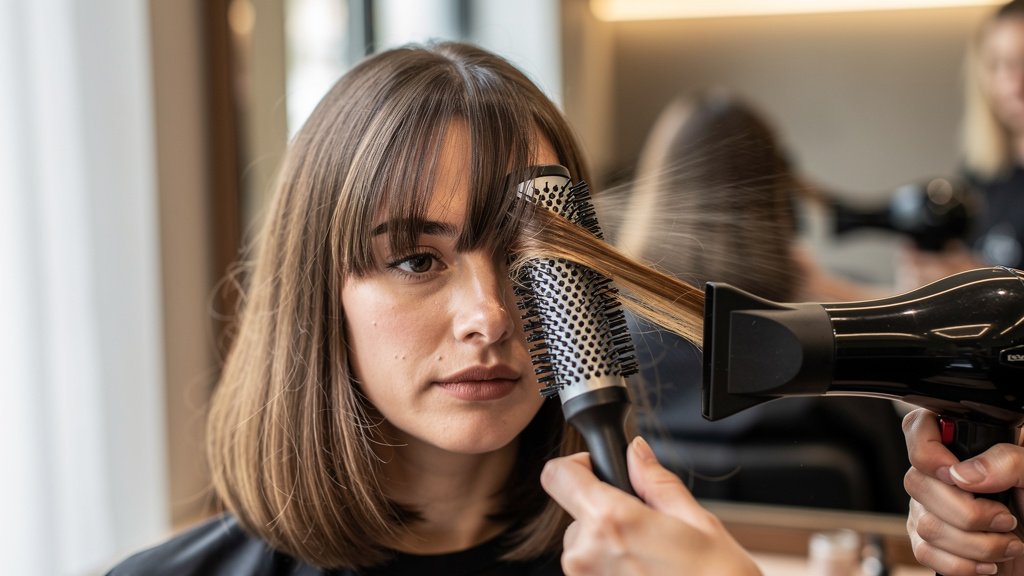
The most classic method for styling curtain bangs involves a blow dryer and round brush, and once you master it, you'll understand why professionals swear by this technique. Start with clean, damp hair bangs shape best when dried from wet or damp state, not fully dry. Apply a light heat protectant to damp strands, then section your hair, working with one side at a time.
According to hairstylist Christina of Olivia Christensen Salon, the key is to blow dry the bangs going away from the face first to create lift at the roots, then flip them back into place. Take a section of your bangs, place the round brush at the root, and blow dry while rotating the brush slightly this creates that signature soft flick at the ends. The motion should be somewhat like drawing a gentle "C" shape as you move from root to tip. Repeat on the other side, and finish with a blast of cool air to set the style.
One common mistake many people make is skipping the heat protectant or trying to style completely dry hair. Both can lead to frizz and lackluster results. If you're short on time or want to minimize heat damage, you can also style curtain bangs on dry hair using the same round brush technique it just requires a bit more patience and perhaps a light misting of water to help the hair hold the new shape.
How to Style Curtain Bangs Without Heat
Not everyone has time for blow drying, and some hair types actually benefit from heat-free methods. The good news is that curtain bangs respond beautifully to no-heat techniques, making them ideal for those who want to minimize styling time or protect delicate strands.
Velcro rollers are the secret weapon for heat-free volume. Simply mist your damp bangs lightly with water or a texturizing spray, then wrap sections around Velcro rollers positioned at the front hairline. Allow the hair to air dry completely this might take an hour or two depending on your hair's thickness and the climate then remove the rollers and finger-comb into place. The result is soft, voluminous bangs with zero heat damage.
Another approach involves simply pinning your damp curtain bangs back with small crease-free clips while you go about your morning routine. After your shower, part your bangs as usual, then use bobby pins or claw clips to secure them away from your face until they dry. Once dry, remove the pins and shake them out for a natural, slightly tousled look. This method works particularly well for those with naturally wavy or curly hair, as the pinned-back drying process helps enhance the natural texture rather than fighting against it.
How Do You Style Curtain Bangs on Different Hair Types?
Fine hair presents unique challenges without enough texture or weight, curtain bangs can fall flat or look limp. Using a smaller round brush and focusing intently on root lift makes a noticeable difference. A volumizing mousse applied before blow drying can also help, but go easy on the product; too much will weigh fine strands down. Texturizing sprays add grip and volume without bulk.
Thick hair requires a different approach. The main concern is controlling the volume rather than creating it. Use a medium-barrel round brush and consider working with smaller sections to ensure you can properly direct the hair where you want it to go. A heat protectant is especially crucial here since thicker hair typically requires more heat and more passes to style. Some stylists also recommend flat ironing thick curtain bangs after blow drying for a smoother, more polished finish.
Curly and textured hair can absolutely pull off curtain bangs the style actually looks stunning with natural curl. The key is working with your hair's natural texture rather than attempting to straighten it into submission. Use a diffuser attachment on your blow dryer and scrunch the hair as you go to encourage the curl pattern. According to Therapy Hair Studio in Houston, "Curtain bangs look incredible on curly and textured hair. Your stylist will just need to adjust the sectioning to account for your hair's natural shrinkage." A leave-in conditioner or curl cream keeps curls defined and cuts down on frizz.
Which Face Shapes Suit Curtain Bangs Best?
One of the most appealing aspects of curtain bangs is their adaptability they can be customized to complement virtually any face shape. For heart-shaped and oval faces, curtain bangs help balance proportions and create a more harmonious overall look, with the middle-short, side-long framing drawing attention to the eyes and cheekbones. Round faces benefit from longer, face-framing versions that create the illusion of length, while square faces can soften their angular jawlines with a slightly curved sweep.
Parting placement changes how curtain bangs interact with your face shape. A center part tends to elongate the face, making it a natural fit for rounder faces, while an off-center part adds asymmetry and visual interest that can flatter longer face shapes. Some people even switch up their part throughout the week a center part for a more polished look, an off-center part for something casual and lived-in.
Finding the perfect curtain bang configuration often requires some experimentation. What looks stunning on one person might fall flat on another, even with identical face shapes, because factors like hair density, natural wave pattern, and lifestyle all play a role. If you're uncertain, booking a consultation with a stylist who specializes in curtain bangs before committing to the cut is a smart first step.
How Do You Maintain and Grow Out Curtain Bangs?
One of the biggest advantages of curtain bangs over traditional blunt fringe is how relatively easy they are to maintain and grow out. Because the hair is longer at the sides, it naturally merges into the rest of your hairstyle as it grows, avoiding that awkward in-between phase that makes blunt bang wearers desperate for a trim. That said, regular trims typically every four to six weeks help maintain the shape and prevent the middle section from becoming too short.
When your curtain bangs start growing out and you decide you're ready for a change, you have options. You can let them grow into face-framing layers that integrate completely with your other hair, or you can ask your stylist to blend them into a shorter fringe if you've decided you want to keep some version of bangs. Many people find that they can go eight to ten weeks between trims during the growing-out phase without the look becoming unwieldy.
Nighttime care matters too. Sleeping on pillowcases made of silk or satin reduces friction and helps your curtain bangs hold their shape overnight, meaning less time spent re-styling in the morning. A loose pineapple ponytail can also help preserve volume for those with finer hair.

What to Keep in Mind Before You Commit
- Curtain bangs are a versatile, face-framing fringe that suits nearly every face shape and hair type when properly customized
- The essential tools include a medium-barrel round brush, blow dryer with concentrator nozzle, and heat protectant
- The classic blow-dry technique involves creating volume at the root with a round brush and a gentle flick at the ends
- No-heat methods like Velcro rollers or air-drying with pinned-back sections work beautifully for those minimizing heat exposure
- Fine hair needs root lift and lightweight products, while thick hair requires control and potentially a flat iron finish
- Curly and textured hair can absolutely wear curtain bangs work with your natural texture rather than against it
- The style grows out more gracefully than blunt bangs, typically requiring trims every four to six weeks to maintain shape