Fashion Punk Style: The Subculture That Rewrote the Rules of Dressing


No aesthetic in modern fashion history has been declared dead and resurrected more times than punk. And yet here we are, with safety pins on Balenciaga coats and tartan trousers in Zara's new-season edit, watching the cycle begin again. Fashion punk style isn't a trend in the conventional sense it's a recurring argument about what clothes are actually for, one that the industry keeps losing and then quietly borrowing from.
The original argument was made in London, in the mid-1970s, in a shop on King's Road called Sex.
Where Fashion Punk Style Actually Came From
Vivienne Westwood who Sky Arts ranked the 4th most influential artist in Britain of the past 50 years in 2022 is largely credited with bringing punk and new wave fashion into the mainstream. But the story is more tangled than that credit suggests. Westwood ran Sex with her then-partner Malcolm McLaren, who also managed the Sex Pistols, and the shop became less a retail space than a provocation in bricks and mortar. McLaren asked Westwood to outfit the band; her designs then found their canvas on Johnny Rotten and Sid Vicious, and suddenly what had been a niche King's Road aesthetic was being photographed, broadcast, and copied across two continents.
Westwood herself described her motivations with characteristic bluntness. According to the Victoria and Albert Museum, which holds key pieces from her career, she said: "I've constantly tried to provoke people into thinking afresh and for themselves, to escape their inhibitions and programming." That sentence explains the whole project better than most academic essays on punk do. The clothes weren't decoration. They were an argument.
What made punk fashion genuinely radical wasn't the leather or the safety pins in isolation it was the deliberate inversion of every signal that "good" dressing was supposed to send. Ripped fabric communicated poverty worn as pride. Bondage trousers referenced transgression. Slogans on T-shirts said things that polite society wasn't supposed to say out loud. The Audaces fashion research platform describes punk style as emerging in the mid-1970s as "a visual response to social frustration and youth dissatisfaction" which is accurate but undersells the aggression of it. This wasn't passive dissatisfaction. It was dissatisfaction dressed up and sent out to cause a scene.
The influences feeding into punk were genuinely eclectic: glam rock's theatrical excess, the hard-edged utility of skinhead dress, the greaser's leather-and-denim romanticism, the mod's sharp tailoring turned inside out. Punk absorbed all of it, distorted it, and spat something new back out. By the time Westwood's shop had been renamed Seditionaries in 1977, the look had a coherent grammar even if the whole point was to break grammatical rules.
The Wardrobe: What Actually Defines the Punk Aesthetic
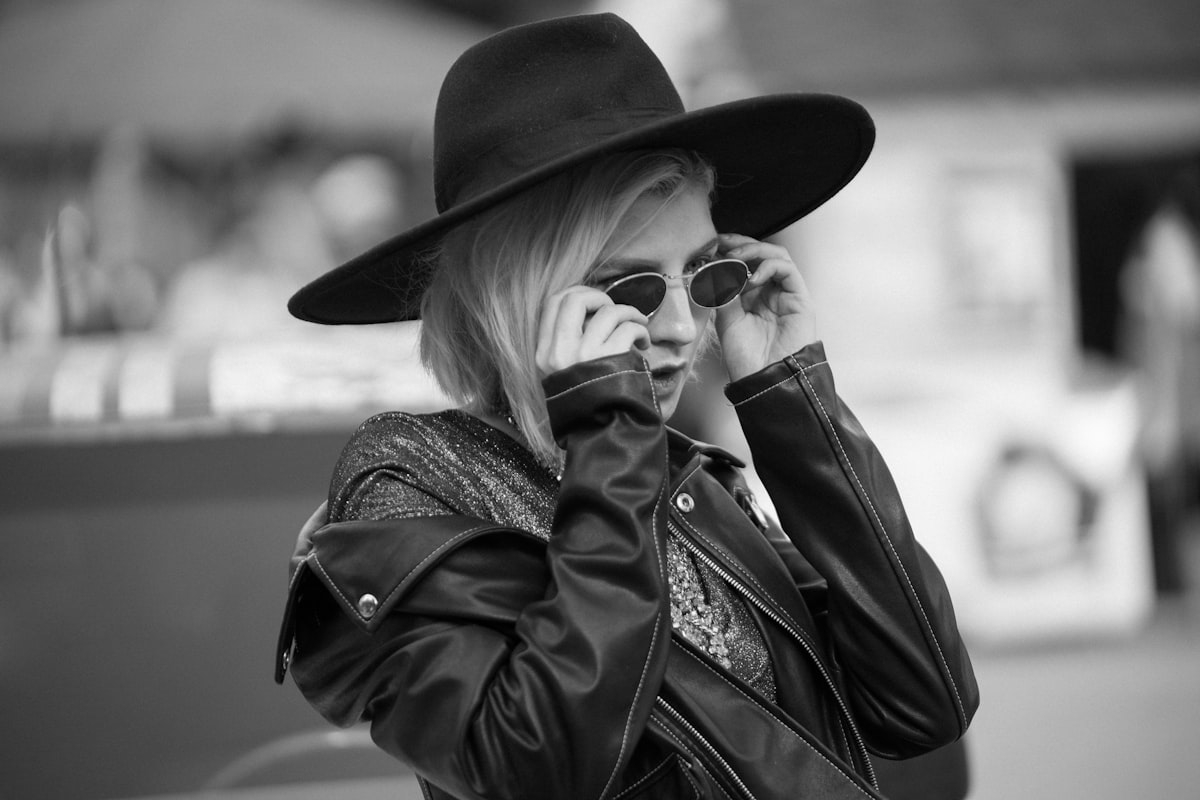
The leather jacket is the load-bearing garment of the entire punk wardrobe, and it earns that status. Originally adopted from motorcycling culture, it carried the right associations danger, speed, outsider status before punk ever touched it. What punk did was transform it from a functional object into a personal manifesto. Jackets were hand-studded, spray-painted, covered in band patches, adorned with slogans, and generally treated as a canvas rather than a coat. The DIY ethic was inseparable from the object itself: you didn't buy a punk jacket, you made one, which meant no two were identical and the whole thing resisted mass production in a way that felt philosophically consistent.
Beyond the jacket, the visual language of punk style draws from a surprisingly coherent set of elements. Tartan specifically the kind associated with the Scottish working class rather than the aristocracy became a punk staple partly because Westwood used it and partly because it read as simultaneously traditional and aggressive. Fishnet tights, worn torn or intact, communicated a deliberate disregard for the convention that hosiery should be invisible. Combat boots grounded the look in utility and working-class reality. Band T-shirts, often deliberately faded or cut up, declared allegiance and attitude simultaneously.
Colour was never neutral in punk. Black dominated because it absorbed everything and gave nothing back. Red appeared in hair and accessories as a signal of intensity. Bleached denim and stark white created contrast. What punk almost never used was the kind of tasteful, coordinated palette that mainstream fashion magazines spent decades promoting the whole point was that "matching" was a bourgeois preoccupation.
Hardware mattered enormously. Pyramid studs on belts and jackets, safety pins worn as jewellery or used to hold ripped fabric together, chains connecting pockets to belt loops these weren't decorative in a conventional sense. They were confrontational. They said: this person has thought about their appearance and chosen this deliberately, which is more subversive than it sounds in a culture that prefers its working-class youth invisible.
The Subgenres Nobody Talks About Enough
Punk is not one thing, and treating it as a monolith is one of the lazier habits in fashion coverage. The dressed-down severity of North American hardcore plain dark clothes, no decoration, almost aggressively anti-fashion has almost nothing in common aesthetically with the elaborate visual theatre of UK street punk, where the Exploited's Mohicans and painted leather jackets were practically performance art. Pop punk, which emerged in the 1990s with bands like Green Day and Blink-182, softened the edges into something more commercially legible: skinny jeans, band tees, pyramid stud belts, skater silhouettes. Japanese punk fashion developed its own distinct visual logic, incorporating elements of Harajuku street style into something that bore a family resemblance to British punk but felt entirely different in execution.
Cyberpunk extended the aesthetic into speculative territory industrial materials, neon accents, a fascination with technology as both threat and ornament and fed directly into the goth and industrial subcultures that followed. Each of these branches has its own internal logic, its own heroes and villains, its own debates about authenticity. The mainstream tends to flatten all of this into a single "punk look" that is really just the most photogenic elements of late-1970s British street punk, which does a disservice to how genuinely varied the tradition actually is.
How Luxury Fashion Has Spent Fifty Years Borrowing From a Movement That Despised It
The relationship between punk and the luxury fashion industry is one of the more entertaining contradictions in the business. Punk was explicitly anti-establishment, anti-consumer, anti-the-kind-of-people-who-spend-money-on-fashion. And yet within a decade of its emergence, every major house was picking through its visual vocabulary for sellable pieces.
Westwood herself is the central irony here. She built her career on punk's energy and then spent the following four decades making tailored suits and evening gowns that sold for thousands of pounds, winning British Fashion Designer of the Year in 1990, 1991, and again in 2006. The V&A notes that in the 30-plus years after her split from McLaren, she "forged a rebel aesthetic that was truly her own" which is a generous way of describing the process by which punk's most famous designer became a luxury brand. I don't say that as a criticism. Westwood never pretended to be consistent, and the tension between rebellion and craft was always part of what made her interesting. But it's worth naming the contradiction clearly.
The Metropolitan Museum of Art's Costume Institute staged "Punk: Chaos to Couture" in 2013, which brought the relationship between punk DIY and high fashion into explicit conversation. The exhibition traced how punk's techniques deconstruction, distressing, strategic ripping, hardware as ornament had been absorbed and refined by designers including Jean Paul Gaultier, Comme des Garçons, and Alexander McQueen. The show was controversial in exactly the right way: some felt it legitimised punk by putting it in a museum; others felt it completed the co-optation that had been underway since the late 1970s.
What the luxury industry has never successfully replicated is the DIY ethic the understanding that a jacket you've studded yourself over three weekends carries a meaning that a pre-studded jacket from a luxury brand simply cannot. The labour is the point. When Balenciaga puts a safety pin on a coat and charges £2,000 for it, the object exists in a completely different semantic universe from the one that produced the original gesture, regardless of how much the visual references overlap. This is the tension that fashion journalists tend to sidestep because it's awkward to write about, but it's the central question the punk aesthetic keeps forcing back onto the table.
Wearing It Now Without Looking Like a Costume
The reason punk keeps cycling back through mainstream fashion is that its core visual moves are genuinely strong. A leather jacket is one of the most versatile garments in existence. Tartan has a graphic intensity that reads in any context. Hardware details add weight and interest to otherwise plain silhouettes. These are real design assets, not just subcultural signals.
The challenge with incorporating punk references into a contemporary wardrobe is calibration specifically, avoiding the Halloween version of punk that comes from applying too many signals at once. A leather jacket over a floral dress, or tartan trousers with a plain white shirt, borrows the energy without the costume effect. The key element is usually restraint: punk style in its original form was maximalist, but that maximalism was earned through the logic of the subculture. Without that context, it reads as fancy dress.
What tends to work in practice is anchoring one strong punk piece a studded belt, a leather jacket, a pair of beaten-up boots in an otherwise straightforward outfit, and letting the contrast do the work. The punk aesthetic has always been about tension: between destruction and construction, between aggression and precision, between the handmade and the found. That tension translates into contemporary dressing when you maintain it rather than resolving it into a single coherent "look."
I'll admit there's a knowledge gap I keep running into here: nobody seems to be tracking with any rigour how Gen Z's relationship to punk style differs from Millennial pop-punk nostalgia. Both are happening simultaneously, and they feel aesthetically distinct the current TikTok-adjacent punk revival has a different visual grammar from the early-2000s Warped Tour throwback but I haven't found research that maps the distinction clearly, and the fashion press tends to collapse them into a single "punk is back" narrative that doesn't quite hold up on inspection.
The DIY Principle, Which Is the Whole Point
Strip away the leather, the tartan, the hardware, and the hair, and what remains of fashion punk style is an instruction: make it yourself, make it yours, and don't ask permission. The DIY ethic wasn't incidental to punk it was the argument. At a moment when mass production was making clothing cheaper and more uniform, punk insisted that the value of a garment came from what you'd done to it, not what you'd paid for it.
That principle has aged better than almost anything else punk produced. In a fashion environment where sustainability conversations are forcing a reckoning with overconsumption, the punk approach to clothing buy less, modify what you have, wear things until they fall apart and then repair them visibly looks less like countercultural posturing and more like a genuinely coherent alternative to the fast fashion model. Whether the fashion industry will ever acknowledge that debt honestly is another question entirely.