Global Gold Jewelry Market: Trends, Cultural Designs, and Market Analysis


Global Gold Jewelry Market: Trends, Cultural Designs, and Market Analysis
The global gold jewelry market represents one of the most enduring segments of the luxury goods industry, blending ancient craftsmanship with contemporary design sensibilities. valued at approximately $180 billion in 2023, this market reflects not just economic trends but deeply cultural relationships with precious metals across civilizations. Understanding these patterns matters for anyone tracking the intersection of fashion, finance, and heritage.
Market Size and Regional Dynamics
The gold jewelry industry distributes unevenly across regions, with Asia-Pacific commanding the largest share of both production and consumption. China and India together account for more than half of global gold jewelry demand, driven by centuries-old traditions of gifting, weddings, and investment holding. The Middle East, particularly Saudi Arabia and the UAE, represents another critical hub where gold jewelry carries profound cultural and religious significance.
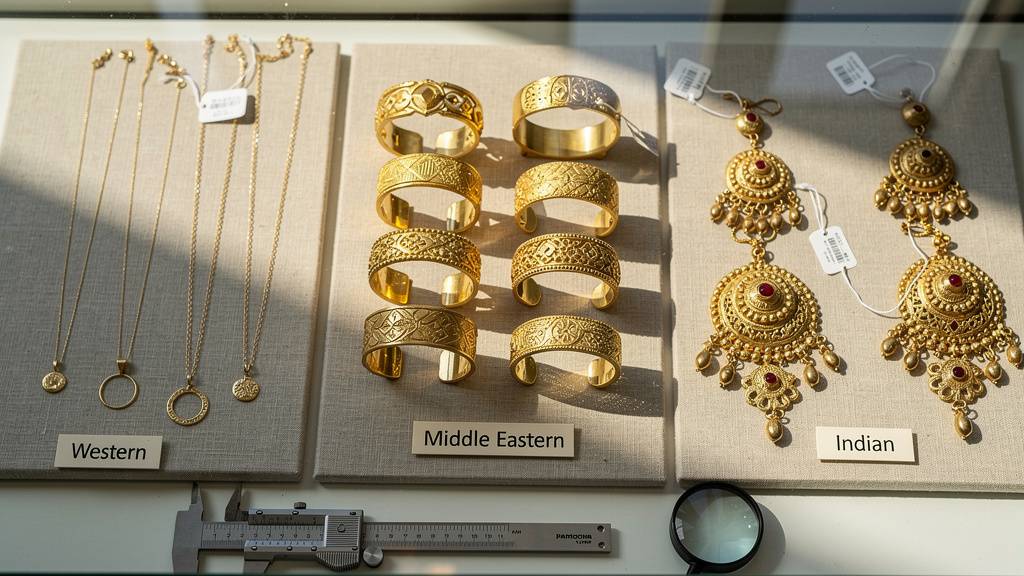
Western markets have evolved differently. In the United States and Europe, gold jewelry has shifted toward fashion-forward pieces where design innovation matters as much as material value. Consumers in these markets increasingly view gold jewelry as an accessory to be layered and rotated rather than a singular investment piece to be stored.
Cultural Design Influences Across Markets
Gold jewelry design never exists in a vacuum it emerges from cultural memory, religious symbolism, and regional identity. In India, the jewelry market revolves around ornate temple-inspired designs, mangalsutra necklaces for married women, and heavy jhumka earrings that communicate family status. Regional variations are striking: South Indian temples favor lotus and deity motifs, while Rajasthani jewelry emphasizes kundan (gemstone setting) techniques passed down through generations.
Chinese gold jewelry design has modernized rapidly while retaining symbolic elements. Dragon and phoenix motifs remain popular for wedding jewelry, representing harmony between husband and wife. The rise of Chinese luxury consumers has pushed domestic brands like Chow Tai Fook and Lukfook to innovate with lighter, everyday-wear pieces that appeal to younger consumers who might previously have avoided traditional gold as "grandmother's jewelry."
The Middle Eastern market demonstrates perhaps the most distinctive design vocabulary. Heavy gold bangles called "khubz," elaborate collar necklaces, and intricate filigree work (called "tari") reflect Gulf region aesthetics where gold jewelry serves as visible wealth and family investment. Recent years have seen a shift toward more wearable daily pieces, but ceremonial pieces for weddings and Eid remain substantial in both size and cultural weight.
How the Market Works: From Mine to Display
Understanding the gold jewelry supply chain illuminates why prices fluctuate and why certain designs dominate certain markets. The journey begins with gold mining, followed by refining and alloying pure 24-karat gold is too soft for most jewelry, so manufacturers combine it with other metals to achieve desired durability and color.
- Gold is extracted from mines (primarily in China, Australia, Russia, and South Africa) and sent to refineries for purification
- Refined gold is sold to manufacturers on commodity markets, with daily spot prices determining baseline costs
- Design houses create collections, either in-house or through freelance designers, often drawing on cultural archives
- Manufacturers produce pieces using techniques ranging from ancient hand-crafting to modern casting
- Wholesale buyers (department stores, jewelry chains, independent retailers) purchase inventory
- Final retail pricing incorporates design premiums, brand markup, and retail margins that can exceed 300% over melt value
The gold jewelry market differs fundamentally from fashion jewelry because the raw material carries intrinsic value. This creates a unique dynamic where consumers in gold-producing or gold-traditional regions view purchases as both aesthetic and financial decisions.
Current Trends Reshaping the Industry
Several interconnected trends are reshaping what gold jewelry means and who buys it. The rise of minimalist gold jewelry in Western markets represents a stark contrast to the heavy, gemstone-accented pieces favored in Asia and the Gulf. Thin chains, delicate stackable rings, and simple hoop earrings have become gateway products for younger consumers entering the gold jewelry category.
Sustainability has moved from buzzword to genuine purchasing criteria. Responsible sourcing initiatives like the Responsible Jewellery Council certification have gained traction, and major retailers increasingly advertise recycled gold credentials. Lab-grown gold, while still a tiny fraction of the market, presents a future challenge to traditional mining-dependent supply chains.
Digital channels have transformed distribution. Online jewelry sales now represent approximately 15% of the global market, up from under 5% before the pandemic. Brands that successfully blend digital discovery with in-store trust where customers can see, touch, and try pieces before committing to four-figure purchases are capturing disproportionate growth.
Types of Gold Jewelry Driving the Market
The market segments into distinct product categories, each with its own design language and consumer base. Investment jewelry heavy, high-karat pieces purchased primarily for gold content dominates in India and the Middle East but has declined in Western markets. Fashion jewelry, by contrast, prioritizes design over material weight and appeals to consumers who view gold as one option among many.
Bridal jewelry represents a category unto itself, representing the largest single purchase category in most markets. Wedding jewelry design varies dramatically by culture: Indian weddings might involve multiple jewelry changes throughout ceremonies, while Western bridal jewelry typically centers on a solitaire diamond engagement ring with a matching gold wedding band.
Lifestyle gold jewelry describes everyday pieces designed for regular wear think charm bracelets, pendant necklaces, and stud earrings. This category has seen the most innovation in design and marketing, with brands repositioning gold as accessible luxury rather than exclusive investment.
Applications and Benefits of Gold Jewelry
Gold jewelry serves functions beyond personal adornment. In many cultures, it functions as emergency wealth storage gold jewelry can be quickly liquidated during financial crises or family emergencies. This dual role as fashion item and portable savings accounts for much of the demand in emerging markets.
The psychological dimension of gold jewelry ownership deserves attention. Research consistently shows that meaningful jewelry pieces associated with milestones, relationships, or achievements provides lasting satisfaction that outpaces the fleeting pleasure of consumable purchases. Gold jewelry specifically carries cultural resonance that amplifies its emotional value.
From an investment perspective, gold has historically served as an inflation hedge. Jewelry offers the advantage of embedded value unlike stocks or bonds, a gold necklace requires no broker and can be physically held. The downside is that retail markups mean jewelry typically loses 20-40% of its gold value the moment it's purchased, making it a poor investment compared to gold bars or ETFs.
Best Practices for Navigating the Gold Jewelry Market
Whether you're a first-time buyer or a seasoned collector, certain principles apply. Understand karat weight: 24-karat is pure gold (too soft for daily wear), 18-karat is 75% gold (ideal for fine jewelry), and 14-karat is 58% gold (more durable, common in fashion jewelry). The lower the karat, the more alloy metals are mixed in, affecting both color and durability.
Check the return policy and buyback terms before buying investment-grade pieces. Reputable jewelers typically offer buyback at or near melt value for their own pieces, while unknown retailers may refuse to repurchase at any price a gap that can quietly gut the actual investment value of what you bought.
For fashion-forward pieces, prioritize design quality and construction over material weight. A well-designed 14-karat piece will outlast and outstyle a poorly made 22-karat piece, and the lower gold content means you're paying more for the designer's vision than the commodity.
Consider the total cost of ownership, including potential resizing, repairs, and cleaning. High-quality gold jewelry can last generations with proper care, but cheap construction leads to broken clasps, lost stones, and ultimately, discard.
Common Mistakes and Misconceptions
One persistent misconception is that higher karat always means better quality. While 24-karat gold is more valuable per gram, its softness makes it unsuitable for most jewelry that will be worn regularly. A well-crafted 18-karat piece will outlast a delicate 24-karat piece, making it the smarter choice for everyday wear.
Another mistake is confusing gold-plated or gold-filled pieces with solid gold. Gold-plated jewelry has a microscopic layer of gold over base metal this layer will wear off within years. Gold-filled uses a thicker gold layer bonded to base metal, lasting longer, but neither approaches the longevity of solid gold.
Many consumers also overestimate gold jewelry's investment potential. Retail prices include substantial markups that you only recover if you sell privately at near-melt values. Gold jewelry should be purchased primarily for enjoyment, with any investment return treated as a secondary benefit.
"The gold jewelry consumer in 2024 is fundamentally different from a decade ago. They want to know the story behind the piece where the gold came from, who designed it, what cultural reference it draws from. Transparency has become a selling point." Sarah Chen, Senior Analyst, Luxury Institute
Frequently Asked Questions
What is the current price of gold and how does it affect jewelry costs?
Gold prices fluctuate daily based on commodity market conditions. As of early 2024, gold trades at approximately $2,000 per ounce. Since jewelry prices incorporate both the gold spot price and design premiums, a simple gold chain might cost 30-50% more than its melt value due to manufacturing and retail margins.
Which country produces the most gold jewelry?
India remains the world's largest gold jewelry producer by volume, followed by China. These two countries account for roughly half of global production, with India alone producing an estimated 700 tonnes of gold jewelry annually.
Is gold jewelry a good investment?
Gold jewelry is a poor investment compared to gold bullion or ETFs because retail markups typically run 30-50% above melt value. You only recover this premium if you sell to a dealer who values the design, which is rare. Consider gold jewelry a consumption purchase first and an investment second.
How do I verify gold purity?
Look for a karat stamp (10K, 14K, 18K, 24K) on the piece. For valuable items, consider professional testing via acid testing or XRF analysis, which reputable jewelers offer. The stamp alone isn't proof counterfeit stamps exist.
What is the difference between gold-filled and solid gold?
Solid gold jewelry is made entirely from gold alloy throughout the piece. Gold-filled has a thick layer of gold bonded to a base metal core typically 5% of the item's total weight is gold. Gold-filled is more durable than gold-plated but won't last generations like solid gold.
What to Keep in Mind Before You Buy
- The global gold jewelry market is valued at approximately $180 billion, with Asia-Pacific representing the largest regional share at 58%
- Cultural design influences vary dramatically: Indian jewelry emphasizes ornate traditional motifs, while Western markets favor minimalist contemporary styles
- Online jewelry sales have grown from under 5% to approximately 15% of the market since the pandemic
- Sustainability and responsible sourcing have become significant purchasing criteria, particularly among younger consumers
- Gold jewelry is a poor investment relative to gold bullion due to retail markups of 30-50%
- Understanding karat weight 18K for fine jewelry, 14K for fashion pieces helps buyers make informed choices
- The market continues evolving as digital channels, sustainability demands, and shifting cultural preferences reshape consumer expectations